Are you having problems at work or with your boss? Here you can learn more about your rights at work. You will find some information on what you can do if your rights are violated.
I am being asked to work without an Arbeitsvertrag (employment contract). What should I do?
Ask for a written Arbeitsvertrag ( employment contract ). In Germany, a written contract is standard. Your employer must give you a document by your first working day at the latest that includes the following information:
- Names and addresses of the contract parties, meaning you and the company
- When the contract begins
- How much you will be paid
- How many days/hours you will work
You should receive a written contract within one month at the latest. The contract must then include additional information. A verbal Arbeitsvertrag (employment contract) is also possible, but a written contract is better. It helps you in case of a dispute, as you can prove what was agreed (for example, how much you will be paid).
Important
When you start working, you have an Arbeitsvertrag (employment contract) . And you have all employment rights—regardless of whether the contract is written or verbal, and regardless of whether you have a work permit or not.
Do I have to work overtime?
Sometimes your Arbeitsvertrag (employment contract) may require you to work overtime. If it doesn’t say so in your contract, you are not required to do overtime. Even then, you are usually not allowed to work more than 8 hours per day, or up to a maximum of 10 hours.
If you are asked to work longer, make sure to note:
- when you were asked to work overtime
- how the request was made
- the exact hours you worked
In most cases, you will either be paid extra for overtime or be able to take time off later. It’s best to agree on this in advance.
Am I allowed to work more than my work permit says?
No. If your work permit states, for example, that you are allowed to work 20 hours per week, you must not work more than that—this also applies to overtime or on-call work.
If your employer still expects you to work more, seek advice at a counseling center.
I have been paid too little or not at all. What can I do?
Write to your employer as soon as possible and demand your wages. This type of letter is called a formal claim. You need to act quickly, even if your employer says the payment is coming. There are deadlines, meaning a limited period in which you can claim your wages. These deadlines are stated in your Arbeitsvertrag (employment contract) .
Exception: For the statutory minimum wage, you have up to three years. Still, act quickly—sometimes employers disappear.
How do I document my work properly?
In some situations, it is important that you can prove your working hours—for example, if you are in a dispute with your employer because wages or overtime have not been paid.
Collect evidence, for example:
- photos at work
- SMS, WhatsApp messages, emails, and other messages
- letters from your employer
- payslips
- receipts
- work clothing or uniform
- work ID
- photos of timesheets or shift schedules
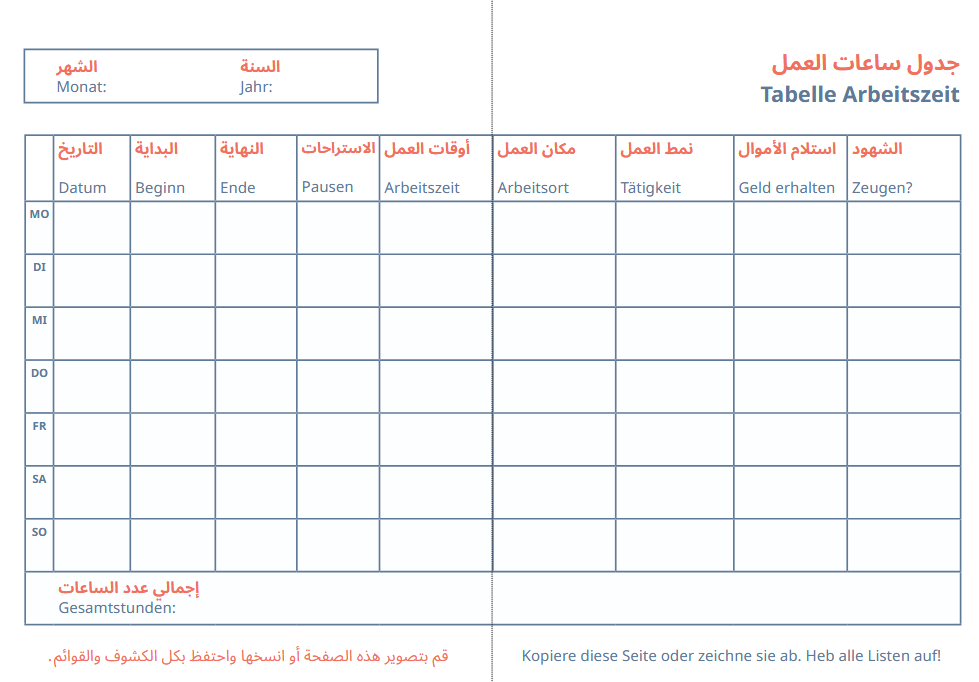
You can find an example in the documents of how to record your daily working hours. Have your manager or a colleague sign the table each day.
What should I do in case of a work accident?
Always report the accident immediately—even if it seems minor. Inform your manager and see a D-Arzt (designated accident doctor). The doctor will report the accident to the Berufsgenossenschaft (accident insurance provider), which covers the costs.
If you are unable to work for more than three days due to the accident, your employer must report it to the Berufsgenossenschaft or the Unfallkasse (accident insurance fund). This is important so that your treatment costs are covered.
You can find more information here:
What should I do if I am dismissed?
First, you should check whether your dismissal is valid. A dismissal must always be in writing—that means on paper with a signature. Verbal dismissals are not valid.
There is a notice period for dismissal. During this time, the employer must continue to pay your wages, and you must continue working. During the probation period, the notice period is often only two weeks. In exceptional cases, there can be immediate dismissal without notice. However, this requires a serious reason, and such dismissals are often not valid. You can have your dismissal reviewed by a court. To do this, you must file a claim. You only have three weeks after the dismissal to do so.
You must also register as a job seeker within three days after receiving the dismissal. You can find more information here:
Seek advice at a counseling center if:
- you were dismissed due to illness or pregnancy
- you received only a verbal dismissal or a dismissal without notice
- your dismissal letter states that you made a mistake
- you are asked to sign a termination agreement and have questions
How much vacation can I take?
By law, you are entitled to at least four weeks of vacation per year. Many companies offer more days—this is stated in your Arbeitsvertrag (employment contract) . You continue to receive your pay while on vacation.
Ask your employer how to request vacation days. Once your vacation is approved, you are allowed to take it.
Here you will find documents and templates. They will help you to enforce your employment rights.
Arbeitsrechte
Arbeitsvertrag
Im Arbeitsvertrag stehen Arbeitsbedingungen, also Regeln und Vereinbarungen für deine Arbeit. Zum Beispiel zu deiner Arbeitszeit, deinem Lohn, deinem Urlaub oder dem Arbeitsort. Du machst den Arbeitsvertrag mit deiner Firma. Ihr beide unterschreibt ihn. Der Arbeitsvertrag kann schriftlich sein (auf Papier, mit Unterschriften) oder er kann mündlich sein (gesprochen, ohne Papier). Ein schriftlicher Vertrag ist besser. Aber auch mit einem mündlichen Vertrag hast du Arbeitsrechte.
Manchmal stehen in deinem Arbeitsvertrag nur wenige Informationen und es wird geschrieben, dass die Regeln aus einem Tarifvertrag gelten. Das bedeutet, dass du keinen eignenen Vertrag mit Regeln nur für dich bekommst. Die Regeln in einem Tarifvertrag wurden von der Gewerkschaft verhandelt. Der Tarifvertrag schützt dich und deine Kolleginnen und Kollegen zum Beispiel vor niedrigen Löhnen.
Du bekommst den Arbeitsvertrag von deiner Firma. Sie sollte dir ein unterschriebenes Papier mit allen Arbeitsbedingungen geben. Du solltest das Papier haben, wenn du die Arbeit anfängst.
Dein Arbeitsvertrag kann anders aussehen, aber er sollte diese Infos haben:
- Vertragsparteien: Name und Adresse von der Firma und von dir
- Vertragsbeginn: Datum vom ersten Arbeitstag
- Arbeitsort: Wo arbeitest du?
- Tätigkeit: Dein Beruf oder deine Aufgaben
- Vergütung: Wie hoch ist der Lohn. Wann bekommst du das Geld?
- Arbeitszeit: Zahl der Arbeitsstunden in der Woche oder im Monat und Überstunden
- Urlaub: Zahl der Urlaubstage im Jahr
- Kündigungsfrist: Zeit zwischen dem Tag der Kündigung und deinem letzten Arbeitstag
- vielleicht: Hinweise auf Tarifverträge
- Datum und Unterschrift: Arbeitgeber und Arbeitnehmer
Arbeitszeitkalender
Ein Arbeitszeitkalender ist ein Dokument. Hier schreibst du auf, wann und wie lange du gearbeitet hast.
So kannst du deine Arbeitszeit nachweisen und zeigen, wie viele Stunden du gearbeitet hast.
Hier findest du Beispiele in verschiedenen Sprachen. Sie zeigen dir, wie du deine Arbeitszeit dokumentieren kannst.
Ein Arbeitszeitkalender ist meist eine Tabelle. Du kannst ihn digital am Computer oder Handy führen.
Du kannst ihn auch selbst mit Stift und Papier machen. Oder du fragst bei BEMA nach einem Ausdruck.
Arbeitszeugnis
Für deine Arbeit kannst du von deiner Firma ein Zeugnis bekommen. Im Arbeitszeugnis steht, was du genau gemacht hast. Im Zeugnis steht auch, wie gut du deine Arbeit gemacht hast.
Für Zeugnisse gibt es eine spezielle Sprache. Wenn in deinem Zeugnis zum Beispiel diese Wörter stehen, dass ist es ein sehr gutes Zeugnis:
- stets zu unserer vollsten Zufriedenheit
- hat unsere Erwartungen immer und in allerbester Weise erfüllt
- Verhalten war stets und in jeder Hinsicht vorbildlich
Du bekommst es von der Firma, bei der du gearbeitet hast oder arbeitest. Frage deinen Chef oder deine Chefin danach.
Do you still have questions? Here you can find free counseling and support in multiple languages.
The information about the counseling services comes from the Berlin Counselling Network for Immigrants (BfZ) and is automatically imported.
Locations in this map
Willkommenszentrum Berlin
Show on mapThe Counselling Centre for Migrants, which has existed since 1981, and the Welcome Centre Berlin, which was founded in 2016, were merged in April 2021.
People with a history of migration and their relatives continue to receive competent advice on all questions of migration as well as arrival and advancement from a single source. The grown team of the Welcome Center and the cooperation partners, including the networks Integration through Qualification (IQ) and bridge, inform, advise and support individually and multilingually.
The following concerns are covered by the Welcome Centre - Counselling Centre of the Integration Officers:
- Legal advice in migration law
- Hardship counselling
- social counselling
- Advice on the recognition of professional qualifications from abroad
- Advice on training and further education, German courses and job search - Advice on setting up a business
- Advice on labour law
Language overview: https://www.berlin.de/willkommenszentru…
Consulting hours of the partners: https://www.berlin.de/willkommenszentru…
Potsdamer Str. 61
10785 Berlin
Germany
[DeepL:] Our consulting takes place on site, by telephone and digitally.
Opening hours:
Mon 9:00-13:00
Tue 9:00-13:00 + 15:00-18:00
Wed 9:00-13:00
Thu 9:00-13:00 + 15:00-18:00
Consultation by e-mail and arrangement of consultation appointments: beratung@intmig.berlin.de
Appointments for consultation by phone:
Mon, Wed, Fri 10:00-12:00 at (030) 9017-23172.
Personal consultation in Ukrainian and Russian
Monday 09 - 13 h
Tuesday 09 to 13 h, 15 to 18 h
Thursday 09 to 13 h, 15 to 18 h
Ban Ying
Show on mapThe counselling at Ban Ying e.V. aims to strengthen the clients' ability to act and assert themselves.
Counselling at Ban Ying e.V. is free of charge.
We advise migrant women regardless of their residence status. We can also provide anonymous counselling on request.
Anklamer Strasse 38
10115 Berlin
Germany
Beratungsstelle für Frauen, die von Menschenhandel betroffen sind
Show on map- Free, anonymous counselling and support for women who involuntarily engage in prostitution and/or are affected by other coercive situations such as trafficking into marriage or trafficking into exploitative employment.
Topics - Crisis intervention
- Initial counselling
- Psychosocial counselling
- Mediation of suitable and safe accommodation options
- Accompaniment during visits to the authorities
- Clarification of residence and social law issues
- Arrangement of medical care
- Support with clarification of legal assistance
- Accompaniment to court proceedings
- Return counselling
- Information and counselling for relatives
Residenz Straße 90
13409 Berlin
Germany
Berliner Beratungszentrum für Migration und Gute Arbeit BEMA
Show on mapThe counselling centre for migrants advises foreign employees of all nationalities free of charge.
Do you work in Berlin and the surrounding area? Do you have questions about:
Unemployment benefit I, Hartz IV - e.g. sanctions, measures, imputations, basic security, asylum seeker benefits law, pension, health and long-term care insurance, severe disability as well as related employment law and residence law issues.
Specific counselling service on Alg II, social assistance and basic security: Tuesdays and Thursdays between 10:30 a.m. and 7 p.m. as needed in German and in English - by appointment only
Lorenzweg 5, Aufgang A, 1. OG
12099 Berlin
Germany
[DeepL:] Please make an appointment.
The current office hours and contacts can be found here:
https://www.bema.berlin/kontakt/
Here you will find short videos with helpful tips and simple explanations.