General Practitioner, Specialist, or Hospital? Find out here where to go if you are ill or have had an accident and what to expect during a visit.
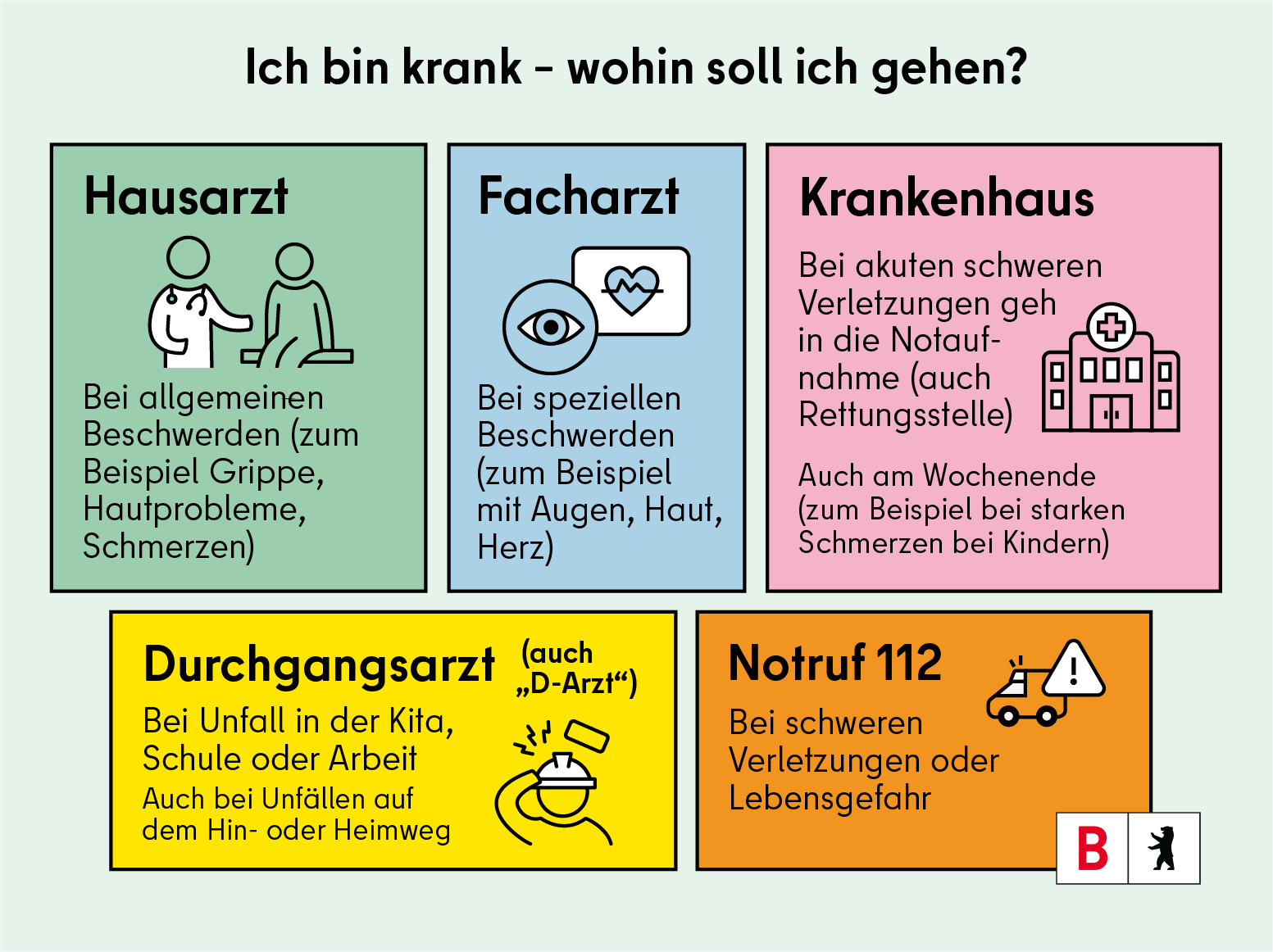
Wohin muss ich gehen, wenn ich krank bin?
Jeder Mensch in Deutschland hat ein Recht auf medizinische Versorgung. Der Hausarzt ist oft die erste Anlaufstelle, wenn du krank bist oder medizinische Fragen hast. Hier bekommst du eine Untersuchung und, wenn nötig, eine Überweisung zu einem Facharzt.
Where Do I Need to Go If I Am Ill?
Everyone in Germany has the right to medical care. A Hausarzt (general practitioner) is often the first point of contact if you are ill or have medical questions. Here, you receive an examination and, if necessary, a referral to a Facharzt (specialist).
You need an appointment for the examination. You can book it by phone or online directly with the practice or through an external online platform for medical appointments. Please note that it can sometimes take months to get an available appointment — especially with specialists. In urgent cases, you may sometimes be seen without an appointment. Ask the practice in advance and expect a longer waiting time.
In an emergency, for example in the case of serious injuries or sudden severe pain, you should go directly to a hospital emergency department or call an emergency service — including at night, on weekends, or on public holidays.
Wichtig
Important: In Germany, everyone must have health insurance in order to receive medical care. In urgent emergencies, hospitals are required to treat you. Do you not have health insurance (yet) or would you like to learn more about the healthcare system in Germany? Find more information here:
The Most Important Free Emergency Numbers
- 112 – Emergency medical services or fire department (for example: accidents, breathing difficulties, unconsciousness)
- 030 192 40 – Berlin Poison Emergency Hotline (for poisoning, for example from medication)
- 116 117 – Medical on-call service (if you are ill but it is not an emergency)
Staff at all emergency hotlines speak English and sometimes other languages. However, this cannot be guaranteed. If you are unsure, ask a German-speaking person to help you make the call.
Pharmacies also operate a rotating emergency service. This means that some pharmacies stay open 24 hours a day to provide medication, including at night. You can find the nearest emergency pharmacy through the Apothekerkammer Berlin (Berlin Chamber of Pharmacists).
Tip: If you are looking for the address of a specific hospital in Berlin, you can find this information in the Berliner Krankenhausverzeichnis (Berlin Hospital Directory). You can find a list of doctors or psychotherapists in Berlin through the Kassenärztlichen Vereinigung Berlin (Association of Statutory Health Insurance Physicians Berlin). Many doctors work in different languages. Ask the practice!
How Does a Visit to a General Practitioner or Specialist Work and What Should I Bring?
If you have an appointment with a Hausarzt (general practitioner) or a Facharzt (specialist), arrive on time. Cancel the appointment if you cannot attend. Some practices charge a fee if you do not cancel. First, go to the reception desk. There, you hand over your health insurance card. After that, you wait until your name is called. Plan enough time for waiting!
Tip: Before each visit, write down your symptoms or the questions you would like to ask. This helps you avoid forgetting anything and make the best use of your time with the doctor. It is helpful for your treatment if you bring diagnoses, laboratory results, or X-rays from previous examinations to your appointment.
When you are called in, the doctor will first ask about your symptoms and examine you. If you need medication, you will receive a prescription (stored on your elektronische Krankenkassenkarte (electronic health insurance card) or printed as a paper prescription). You can use it to collect your medication from a pharmacy.
What Do I Need to Do If I Am Ill and Unable to Work?
If you are ill and cannot work, you need a sick note for your employer. Here you can see what you need to do on each day of your illness:
Day 1–3: Inform your employer if you are ill
Notify your employer by phone or email that you are ill. One sentence is enough: "I am reporting sick for today." You must do this again each day from day 1 to day 3 of your illness.
Day 4 (or earlier for some employers): You need a sick note from a doctor.
Go to your Hausarzt (general practitioner). There, you will receive a sick note, also called an Arbeitsunfähigkeitsbescheinigung (AU) (certificate of incapacity for work). It states how many days you are certified as unable to work. You then contact your employer by phone or email and inform them how long your sick leave lasts.
Digital sick note (eAU) is sent automatically to the health insurance provider and employer
The practice sends your sick note automatically to your health insurance provider and your employer. The first time, ask your employer and the practice how the procedure works in your case.

More Information on This Topic
Here you can find more questions and answers about reporting sick leave.
The page is available in multiple languages.
Locations in this map
Medibüro Berlin
Show on mapMedibüro Berlin does not offer medical treatment itself, but arranges anonymous and free treatment by qualified medical professionals for migrants without residence status and without health insurance.
If necessary, we can provide financial support for aids or medication. It is not possible to provide financial support for medication in the case of chronic illnesses, in the case of serious, long-term illnesses or for subsequent reimbursement of costs for medical treatment or medication. In these cases, we try to find and refer alternative solutions.
Gneisenaustraße 2a
10961 Berlin
Germany
[DeepL:] Monday 15:30-18:30